Biosynthesizing Rare Alkaloids: The Future of Neuro-Pharma
The pharmaceutical industry is entering a transformative era where biology, chemistry, and biotechnology converge to create groundbreaking treatments for neurological disorders. Among the most promising developments is the biosynthesis of rare alkaloids—complex, naturally occurring compounds that have long fascinated scientists because of their remarkable effects on the human nervous system. Traditionally obtained from rare plants, fungi, or marine organisms, many of these alkaloids are difficult to produce in sufficient quantities. Modern biosynthetic technologies are changing that reality, opening new possibilities for neuro-pharmaceutical innovation.
Understanding Rare Alkaloids
Alkaloids are naturally occurring organic compounds that contain nitrogen atoms and are produced by a wide variety of living organisms. They often serve as natural defense mechanisms against predators, insects, or microbial infections. For humans, however, these compounds have proven to be valuable medicinal agents.
Some well-known alkaloids include morphine, quinine, caffeine, nicotine, and galantamine. While these compounds are relatively accessible, many rare alkaloids exist only in trace amounts within endangered plants or slow-growing organisms. Their scarcity has historically limited scientific research and commercial drug development.
Rare alkaloids possess highly specialized molecular structures that allow them to interact precisely with neurotransmitter receptors, ion channels, and enzymes within the brain. These interactions make them attractive candidates for treating neurological diseases.
Why Neuro-Pharma Needs New Solutions
Neurological disorders continue to rise worldwide due to aging populations and increasing life expectancy. Diseases such as Alzheimer’s, Parkinson’s, epilepsy, multiple sclerosis, depression, anxiety, and chronic neuropathic pain affect hundreds of millions of people.
Although current medications provide symptom relief, many suffer from significant drawbacks:
- Limited long-term effectiveness
- Undesirable side effects
- Drug resistance
- Poor selectivity
- High treatment costs
Rare alkaloids offer the possibility of developing highly targeted therapies that act on previously unexplored biological pathways. Their unique molecular diversity gives researchers opportunities to design medications with improved safety and efficacy.
Biosynthesis: A Sustainable Alternative
Harvesting rare medicinal plants from nature is neither environmentally sustainable nor economically practical. Some species require decades to mature, while others grow only in specific ecological regions. Overharvesting threatens biodiversity and limits pharmaceutical production.
Biosynthesis provides an elegant alternative.
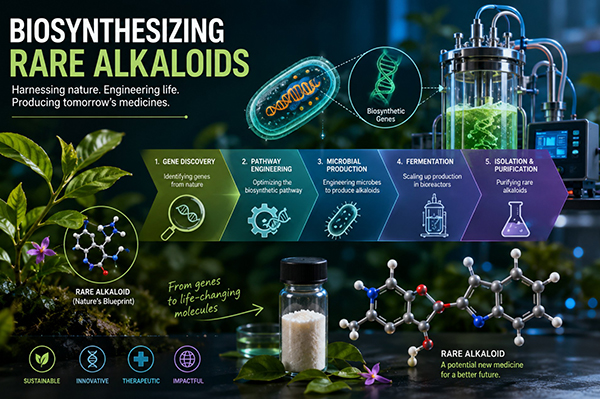
Using synthetic biology, scientists engineer microorganisms such as yeast, bacteria, or fungi to produce valuable alkaloids through controlled fermentation. Instead of extracting milligrams from thousands of plants, researchers can cultivate engineered microbes inside bioreactors capable of generating consistent supplies.
This approach offers several advantages:
- Renewable production
- Lower environmental impact
- Reduced manufacturing costs
- Consistent product quality
- Faster scalability
- Improved purity
As genome editing technologies continue to improve, biosynthetic production becomes increasingly efficient.
Engineering Nature’s Chemical Factories
The biosynthesis of rare alkaloids relies heavily on metabolic engineering. Researchers identify the genes responsible for producing target molecules within plants and insert those genetic pathways into fast-growing microbial hosts.
The process generally includes several stages:
- Genome sequencing of medicinal plants.
- Identification of biosynthetic enzymes.
- Gene synthesis and optimization.
- Assembly of metabolic pathways.
- Fermentation optimization.
- Purification of the desired alkaloid.
Advanced computational biology assists researchers in predicting enzyme functions and improving metabolic efficiency. Artificial intelligence further accelerates pathway optimization by identifying bottlenecks and suggesting genetic modifications.
Applications in Neuro-Pharmaceutical Development
Rare alkaloids demonstrate enormous potential across multiple neurological conditions.
Alzheimer’s Disease
Certain alkaloids enhance acetylcholine signaling by inhibiting acetylcholinesterase enzymes. Improved neurotransmission may help preserve memory and cognitive performance in patients experiencing neurodegeneration.
Biosynthetic production ensures a reliable supply of these promising molecules while enabling structural modifications that improve drug performance.
Parkinson’s Disease
Some naturally occurring alkaloids influence dopamine metabolism and protect neurons from oxidative stress. Engineered variants may slow disease progression while reducing movement disorders.
Researchers are also investigating compounds that prevent the accumulation of toxic proteins associated with Parkinson’s disease.
Depression and Anxiety
Novel alkaloids interact with serotonin, dopamine, and glutamate signaling pathways in unique ways. Unlike conventional antidepressants, these compounds may produce faster therapeutic responses with fewer side effects.
Their ability to regulate neuroplasticity has generated considerable interest in psychiatric medicine.
Chronic Pain
Traditional opioid alkaloids effectively relieve pain but carry risks of addiction and respiratory depression. Biosynthetic engineering enables scientists to modify these molecules, potentially separating pain relief from addictive properties.
Such innovations could transform pain management worldwide.
Epilepsy
Rare alkaloids capable of modulating neuronal excitability may offer new treatments for drug-resistant epilepsy. Precision targeting of ion channels could improve seizure control while minimizing cognitive impairment.
Artificial Intelligence Accelerates Discovery
Artificial intelligence has become an essential partner in alkaloid research. Machine learning algorithms analyze enormous biochemical datasets to identify promising compounds and predict biological activity.
AI assists researchers by:
- Predicting molecular structures
- Designing biosynthetic pathways
- Optimizing fermentation conditions
- Screening millions of compound variants
- Forecasting toxicity profiles
- Accelerating clinical candidate selection
Combined with robotic laboratory automation, AI dramatically reduces the time required to move from discovery to clinical testing.
Personalized Neuro-Pharma
Future neuro-pharmaceutical treatments may become increasingly personalized.
Genomic sequencing allows physicians to identify genetic variations influencing drug metabolism and disease progression. Biosynthesized alkaloids can then be optimized for individual patients, maximizing therapeutic benefit while minimizing adverse reactions.
Precision medicine may eventually combine:
- Genetic testing
- Biomarker analysis
- AI-driven diagnosis
- Personalized biosynthetic drugs
Such integrated healthcare approaches promise significantly better patient outcomes.
Challenges Ahead
Despite remarkable progress, several obstacles remain.
The biosynthetic pathways of many rare alkaloids remain incompletely understood. Some involve dozens of enzymes working together in complex cellular environments, making pathway reconstruction technically difficult.
Additional challenges include:
- Regulatory approval
- Manufacturing scale-up
- Intellectual property issues
- Long clinical trials
- Production stability
- Public acceptance of synthetic biology
Nevertheless, continuous advances in biotechnology are steadily overcoming these limitations.
Ethical and Environmental Considerations
Biosynthesizing rare alkaloids provides significant environmental benefits by reducing pressure on endangered medicinal plants and fragile ecosystems. Sustainable fermentation minimizes land use, decreases chemical waste, and lowers carbon emissions compared with traditional extraction methods.
Ethically, researchers must ensure equitable access to resulting therapies while respecting indigenous knowledge that contributed to the discovery of many medicinal plants. Fair benefit-sharing agreements and biodiversity conservation remain essential components of responsible pharmaceutical development.
Looking Toward the Future
The next decade is expected to witness rapid expansion in biosynthetic neuro-pharmaceutical research. Improved gene editing technologies, automated laboratories, advanced fermentation systems, and increasingly sophisticated AI tools will continue driving innovation.
Scientists may soon produce entirely new classes of alkaloids that never existed in nature, combining desirable characteristics from multiple biosynthetic pathways. These designer molecules could offer unprecedented precision in treating neurological diseases.
As healthcare shifts toward precision medicine, biosynthesized alkaloids are poised to become foundational components of next-generation neurological therapies.
Conclusion
Biosynthesizing rare alkaloids represents one of the most exciting frontiers in modern pharmaceutical science. By combining synthetic biology, metabolic engineering, artificial intelligence, and precision medicine, researchers are overcoming the limitations of natural extraction and creating sustainable pathways to life-changing therapies.
Although technical and regulatory challenges remain, the progress achieved so far demonstrates extraordinary potential. From Alzheimer’s disease and Parkinson’s disease to depression, chronic pain, and epilepsy, biosynthesized alkaloids may redefine how neurological disorders are treated in the coming decades.
The future of neuro-pharma will not depend solely on discovering new drugs in nature—it will increasingly rely on our ability to engineer biology itself, transforming rare natural compounds into accessible, scalable, and highly effective medicines for patients around the world.