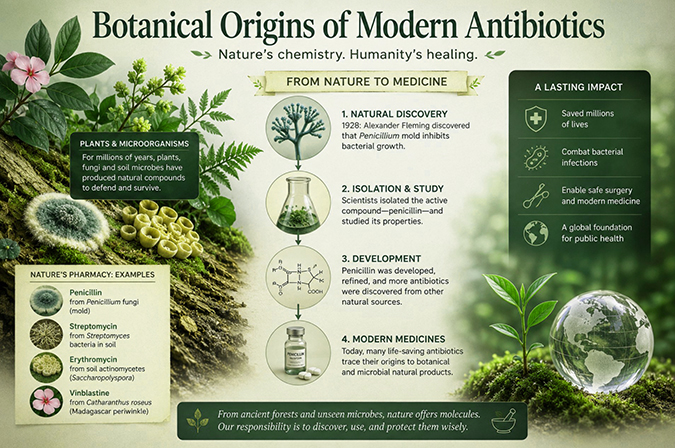
Botanical Origins of Modern Antibiotics: Reviving Ancient Phytochemicals
Introduction
The rise of antibiotic-resistant bacteria has become one of the greatest public health challenges of the 21st century. For decades, synthetic antibiotics have transformed modern medicine by treating infections that were once fatal. However, excessive use, misuse, and bacterial evolution have significantly reduced the effectiveness of many conventional drugs. As scientists search for innovative solutions, they are increasingly turning their attention toward nature’s oldest pharmacy—plants.
Long before the discovery of penicillin, ancient civilizations relied on medicinal plants to treat wounds, infections, and inflammatory diseases. These botanical remedies contained naturally occurring compounds known as phytochemicals, many of which possess remarkable antimicrobial properties. Today, advances in biotechnology, pharmacology, and molecular biology are enabling researchers to rediscover these ancient substances and evaluate their potential as the foundation for the next generation of antibiotics.
This renewed interest represents more than a nostalgic return to traditional medicine. It is a scientifically grounded effort to harness plant-derived bioactive compounds that have evolved over millions of years as natural defenses against microbial pathogens.
Ancient Plant Medicine: Humanity’s First Antibiotic Arsenal
Historical records reveal that medicinal plants have served as antimicrobial agents across nearly every civilization.
Ancient Egyptian physicians used garlic, onion, and honey to prevent wound infections. Traditional Chinese medicine prescribed herbs such as goldthread and skullcap to combat bacterial illnesses. Indian Ayurveda incorporated turmeric, neem, and holy basil into treatments for skin diseases and digestive infections. Indigenous communities throughout Africa, South America, and Oceania similarly relied on local flora to manage infectious diseases long before the advent of synthetic pharmaceuticals.
Although ancient healers lacked knowledge of bacteria or molecular chemistry, centuries of empirical observation enabled them to identify plants with genuine therapeutic benefits. Modern analytical techniques now confirm that many of these traditional remedies contain potent antimicrobial molecules.
These discoveries validate traditional botanical knowledge while providing valuable leads for contemporary drug development.
Understanding Phytochemicals
Phytochemicals are naturally occurring chemical compounds produced by plants as protective mechanisms against insects, fungi, bacteria, viruses, and environmental stress.
Unlike nutrients such as carbohydrates or proteins, phytochemicals primarily function as defense molecules. Their remarkable structural diversity makes them attractive candidates for pharmaceutical research.
Major antimicrobial phytochemical groups include:
- Alkaloids
- Flavonoids
- Terpenoids
- Phenolic acids
- Tannins
- Saponins
- Coumarins
- Quinones
- Essential oils
- Organosulfur compounds
Each group attacks microorganisms through different biological pathways, reducing the likelihood that bacteria can rapidly develop resistance.
How Plant-Derived Compounds Fight Bacteria
Unlike many conventional antibiotics that target a single bacterial process, phytochemicals frequently employ multiple mechanisms simultaneously.
These mechanisms include:
- Damaging bacterial cell walls
- Disrupting cell membranes
- Inhibiting protein synthesis
- Blocking DNA replication
- Preventing biofilm formation
- Interrupting bacterial communication (quorum sensing)
- Reducing bacterial toxin production
- Enhancing immune responses
Because multiple targets are affected at once, bacteria face greater evolutionary challenges when attempting to develop resistance.
This multi-target approach has become one of the most attractive features of botanical antimicrobial research.
Remarkable Plants Inspiring Modern Antibiotics
Garlic (Allium sativum)
Garlic has been used medicinally for thousands of years.
Its active compound, allicin, demonstrates strong antibacterial activity against both Gram-positive and Gram-negative bacteria. Researchers have shown that allicin interferes with essential bacterial enzymes while disrupting microbial metabolism.
Garlic extracts are currently being investigated as adjunct therapies to improve antibiotic effectiveness.
Turmeric (Curcuma longa)
Curcumin, turmeric’s principal bioactive compound, is widely recognized for its anti-inflammatory properties.
Recent research also demonstrates its antimicrobial potential against various bacterial strains, including antibiotic-resistant organisms.
Curcumin may weaken bacterial defenses, making pathogens more vulnerable to conventional antibiotics.
Neem (Azadirachta indica)
Neem contains dozens of bioactive compounds possessing antibacterial, antiviral, antifungal, and anti-inflammatory activities.
Traditional medicine has long employed neem leaves, bark, and oil to treat skin infections, dental diseases, and wounds.
Scientists continue exploring neem-derived molecules for pharmaceutical applications.
Tea Tree (Melaleuca alternifolia)
Tea tree essential oil contains terpinen-4-ol, a compound with significant antimicrobial activity.
Its effectiveness against skin pathogens has led to widespread use in dermatological products targeting acne, fungal infections, and minor wounds.
Goldenseal (Hydrastis canadensis)
Goldenseal contains berberine, one of the most extensively studied plant alkaloids.
Berberine exhibits antibacterial activity by interfering with bacterial DNA replication while also inhibiting biofilm formation.
Researchers are investigating combinations of berberine with existing antibiotics to improve treatment outcomes.
Fighting Antibiotic Resistance with Botanical Synergy
One particularly exciting area of research involves combining plant compounds with existing antibiotics.
Certain phytochemicals enhance antibiotic performance by:
- Increasing bacterial membrane permeability
- Blocking bacterial resistance pumps
- Inhibiting resistance enzymes
- Disrupting protective biofilms
- Suppressing virulence factors
This phenomenon, known as synergistic antimicrobial activity, allows lower antibiotic doses while maintaining or even improving treatment effectiveness.
Reducing dosage requirements may decrease side effects and slow the emergence of antibiotic resistance.
Biofilms: A Hidden Challenge
Many dangerous bacteria form biofilms—complex microbial communities enclosed within protective extracellular matrices.
Biofilms make infections substantially harder to treat because antibiotics often struggle to penetrate these protective structures.
Examples include:
- Chronic wound infections
- Dental plaque
- Catheter-associated infections
- Prosthetic joint infections
- Lung infections in cystic fibrosis
Several plant-derived compounds have demonstrated impressive anti-biofilm capabilities.
Flavonoids, tannins, and essential oils can interfere with bacterial adhesion, biofilm maturation, and microbial communication, improving antibiotic access to hidden bacteria.
Modern Technologies Accelerating Botanical Drug Discovery
Today’s researchers possess sophisticated technologies unimaginable to ancient herbalists.
Artificial intelligence can rapidly identify promising phytochemicals from massive chemical databases.
High-throughput screening enables scientists to test thousands of plant extracts against resistant bacteria within days.
Metabolomics maps complex plant chemical profiles with extraordinary precision.
Genomics helps identify bacterial vulnerabilities targeted by phytochemicals.
Nanotechnology further enhances botanical medicine by improving compound stability, absorption, and targeted delivery.
These innovations significantly accelerate the transformation of traditional herbal remedies into evidence-based pharmaceuticals.
Challenges in Developing Plant-Based Antibiotics
Despite enormous promise, botanical drug development presents several obstacles.
Chemical Complexity
Plants often contain hundreds of interacting compounds, making it difficult to isolate the precise molecules responsible for therapeutic effects.
Standardization
Environmental factors—including climate, soil composition, harvest timing, and processing methods—can substantially alter phytochemical concentrations.
Maintaining pharmaceutical consistency requires rigorous cultivation and quality control standards.
Clinical Validation
Many promising plant compounds demonstrate excellent laboratory activity but require extensive human clinical trials to establish safety, dosage, efficacy, and potential interactions with existing medications.
Sustainable Harvesting
Growing demand for medicinal plants raises concerns regarding biodiversity conservation and environmental sustainability.
Responsible cultivation practices and synthetic production methods may help reduce pressure on wild plant populations.
The Role of Ethnobotany
Ethnobotany—the scientific study of relationships between people and plants—plays an increasingly important role in antibiotic discovery.
Traditional healers possess generations of knowledge regarding medicinal species that may otherwise remain scientifically unexplored.
Collaborative research between indigenous communities and pharmaceutical scientists has already led to numerous valuable discoveries.
Ethical partnerships ensure that traditional knowledge holders receive recognition and equitable benefits from commercial developments derived from their cultural heritage.
The Future of Botanical Antibiotics
Future antimicrobial therapies may combine synthetic chemistry with nature-inspired design.
Instead of replacing conventional antibiotics entirely, plant-derived compounds could serve as:
- Antibiotic enhancers
- Resistance inhibitors
- Immune modulators
- Anti-biofilm agents
- Preventive antimicrobial supplements
- Templates for entirely new drug classes
Researchers are increasingly recognizing that nature’s immense chemical diversity represents an underexplored resource in the global fight against infectious disease.
As antibiotic resistance continues expanding worldwide, botanical research offers renewed optimism.
Conclusion
The botanical origins of modern antibiotics remind us that nature has spent millions of years perfecting sophisticated chemical defenses against microbial threats. Ancient civilizations unknowingly harnessed these protective compounds through traditional herbal medicine, laying the foundation for many modern pharmacological discoveries.
Today, advanced scientific techniques are breathing new life into these ancient phytochemicals. By understanding their molecular mechanisms, improving their delivery systems, and combining them strategically with existing antibiotics, researchers are developing innovative approaches to combat resistant pathogens.
Reviving ancient botanical wisdom does not mean abandoning modern medicine. Instead, it represents the integration of traditional knowledge with cutting-edge science. This partnership between the past and the future may ultimately provide the next generation of antimicrobial therapies, helping humanity overcome one of the greatest medical challenges of our time while preserving the extraordinary pharmaceutical potential hidden within the world’s diverse plant kingdom.