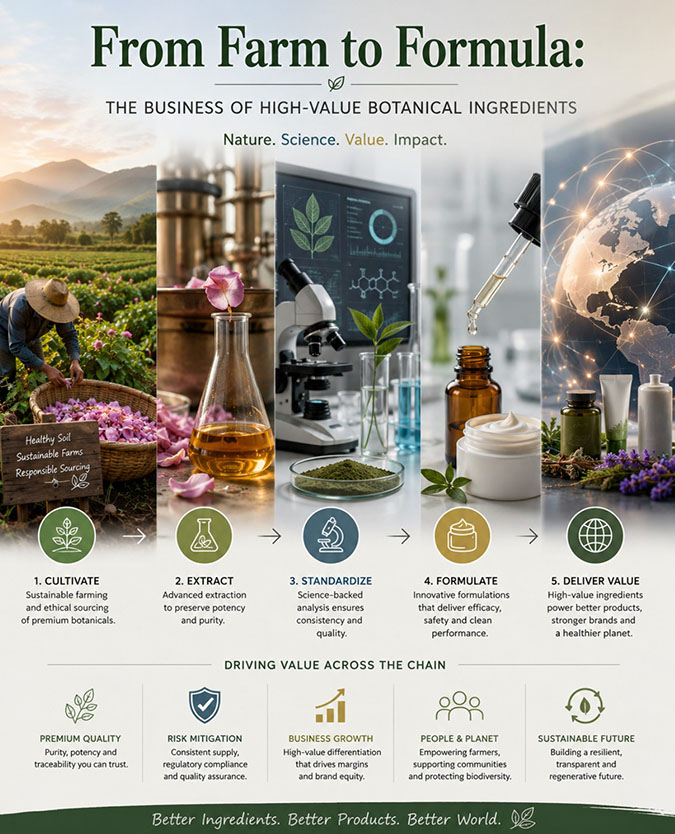
From Farm to Formula: The Business of High-Value Botanical Ingredients
In recent years, the global wellness economy has experienced a dramatic transformation. Consumers are no longer satisfied with synthetic additives, artificial fragrances, or chemically engineered health products. Instead, they are searching for authenticity, sustainability, and nature-based solutions. This shift has created a booming market for high-value botanical ingredients—plant-derived compounds used in cosmetics, pharmaceuticals, nutraceuticals, food products, and personal care formulations.
From turmeric fields in India to lavender farms in France and tropical herbal plantations in Southeast Asia, botanical ingredients are becoming some of the most profitable agricultural commodities in the modern economy. Yet the journey from farm to formula is far more complex than simply harvesting plants and selling extracts. It is a sophisticated global business involving agriculture, biotechnology, supply chain management, branding, sustainability, and scientific innovation.
The Rising Demand for Botanical Ingredients
Consumers today are more informed than ever before. Labels such as “natural,” “organic,” “plant-based,” and “clean beauty” strongly influence purchasing decisions. As a result, companies across multiple industries are investing heavily in botanical research and ingredient sourcing.
The skincare sector, for example, increasingly relies on botanical extracts such as aloe vera, chamomile, green tea, and centella asiatica. Meanwhile, the nutraceutical industry uses herbs like ashwagandha, ginseng, and turmeric to formulate supplements aimed at stress reduction, immunity, and cognitive support.
Several factors are driving this demand:
- Increased awareness of holistic wellness
- Consumer distrust of synthetic chemicals
- Growth of the organic product market
- Expansion of herbal medicine research
- Social media influence on wellness trends
- Sustainability concerns among younger consumers
What was once considered traditional herbal knowledge has now evolved into a multi-billion-dollar global industry.
The Agricultural Foundation
At the heart of every botanical ingredient lies agriculture. Farmers are the first and perhaps most important players in the value chain. However, cultivating medicinal and aromatic plants differs significantly from conventional farming.
High-value botanicals require careful environmental conditions, harvesting methods, and post-harvest handling to preserve their active compounds. Soil quality, climate, irrigation, altitude, and harvesting time all influence the potency and commercial value of the final ingredient.
For example, peppermint cultivated for essential oil production must be harvested at the precise stage of oil concentration. Similarly, turmeric intended for curcumin extraction requires optimized drying and storage processes to maintain quality.
Many companies now work directly with farmers through contract farming systems. This approach ensures consistent quality while giving growers stable income opportunities. In some regions, botanical farming has become a powerful tool for rural economic development.
Countries such as India, Indonesia, Madagascar, Morocco, and Peru are emerging as strategic suppliers of rare and valuable plant materials. These regions possess rich biodiversity and traditional agricultural knowledge that multinational companies increasingly depend upon.
Extraction: Turning Plants into Premium Ingredients
The true commercial value of botanical crops emerges during processing and extraction. Raw plant material alone often has limited profitability. However, when transformed into concentrated extracts, essential oils, powders, or bioactive compounds, their value increases dramatically.
Extraction technologies vary depending on the desired outcome. Common methods include:
- Steam distillation
- Cold pressing
- Solvent extraction
- CO2 extraction
- Fermentation-based processing
- Water extraction
Modern biotechnology is also reshaping the industry. Scientists now isolate specific plant compounds responsible for therapeutic or cosmetic effects. These concentrated actives can then be standardized for consistent performance in commercial formulations.
For example, curcumin extracted from turmeric is used in anti-inflammatory supplements, while polyphenols from green tea are added to anti-aging skincare products. Such specialized extracts command significantly higher prices than raw agricultural products.
This processing stage is where agriculture intersects with science, creating a bridge between traditional farming and modern industrial innovation.
The Role of Research and Development
Scientific validation has become essential in the botanical ingredient business. Consumers and regulators increasingly demand evidence supporting claims related to efficacy, safety, and sustainability.
As a result, research and development departments play a critical role in product commercialization. Companies invest heavily in laboratory studies, clinical trials, and ingredient standardization.
Botanical research focuses on several areas:
- Identifying active compounds
- Measuring antioxidant activity
- Evaluating anti-inflammatory effects
- Improving extraction efficiency
- Enhancing bioavailability
- Developing sustainable cultivation methods
Collaboration between universities, biotech firms, and ingredient manufacturers has accelerated innovation. Ancient medicinal plants once used in traditional healing systems are now studied using advanced analytical technologies.
This scientific backing helps companies position botanical ingredients as premium solutions in highly competitive markets.
Sustainability as a Competitive Advantage
Sustainability is no longer optional in the botanical ingredient industry. Environmental concerns and ethical sourcing practices strongly influence purchasing behavior and corporate reputation.
Overharvesting of wild plants has become a major challenge in some regions. Rare species used in cosmetics or herbal medicine face pressure from growing global demand. To address this issue, companies increasingly adopt sustainable cultivation programs and regenerative farming practices.
Traceability has also become a key business strategy. Consumers want transparency about where ingredients come from, how they are produced, and whether local communities benefit economically.
Many premium brands now market their products based on:
- Fair trade sourcing
- Organic certification
- Carbon-neutral production
- Biodiversity protection
- Ethical labor practices
- Regenerative agriculture
In many cases, sustainability itself becomes a powerful marketing asset. Brands that successfully combine environmental responsibility with product performance often achieve stronger consumer loyalty.
The Power of Storytelling in Botanical Branding
One fascinating aspect of the botanical ingredient business is the importance of storytelling. Consumers are emotionally drawn to products connected to nature, tradition, and cultural heritage.
A skincare cream made with “wild-harvested Moroccan argan oil” carries a stronger emotional appeal than a generic cosmetic formulation. Likewise, supplements featuring “ancient Ayurvedic herbs” tap into consumer fascination with traditional wellness systems.
Companies understand that storytelling adds perceived value. Therefore, branding often highlights:
- Indigenous farming traditions
- Exotic geographic origins
- Sustainable harvesting methods
- Artisan extraction techniques
- Cultural wellness practices
- Small-farm partnerships
The narrative surrounding an ingredient can sometimes become nearly as valuable as the ingredient itself.
This branding strategy explains why botanical ingredients frequently dominate luxury wellness markets despite higher production costs.
Supply Chain Challenges and Risks
Despite its growth potential, the botanical ingredient industry faces significant operational challenges.
Climate change is one major threat. Droughts, floods, and unpredictable weather patterns directly impact crop quality and availability. Since many medicinal plants are sensitive to environmental changes, supply instability can create price volatility.
Another challenge involves adulteration and fraud. Some suppliers dilute essential oils or substitute lower-quality materials to reduce costs. This creates serious quality control concerns for manufacturers.
Regulatory compliance also varies across countries. Companies must navigate complex rules regarding safety testing, labeling, export standards, and health claims.
Additionally, geopolitical instability and transportation disruptions can affect international supply chains. Since many botanical ingredients originate from remote regions, logistics management becomes especially important.
To reduce risk, companies increasingly diversify sourcing locations and invest in long-term supplier relationships.
Technology and the Future of Botanicals
Technology is rapidly reshaping the future of botanical ingredients. Artificial intelligence, blockchain, biotechnology, and precision agriculture are creating new opportunities for efficiency and transparency.
AI-driven analytics help researchers identify promising plant compounds faster than traditional methods. Blockchain systems improve traceability by documenting every stage of the supply chain. Precision agriculture technologies optimize irrigation, fertilizer use, and crop monitoring.
Meanwhile, cellular agriculture and plant tissue culture may eventually reduce pressure on endangered species by producing botanical compounds in laboratory environments.
Biotechnology firms are also exploring synthetic biology approaches that replicate plant molecules without relying entirely on traditional farming. While controversial in some markets, these innovations could address supply shortages and environmental concerns.
Nevertheless, consumer preference for authentic natural sourcing remains strong. As a result, companies must balance technological advancement with the emotional and ethical appeal of nature-based products.
Opportunities for Emerging Markets
Developing countries possess enormous potential within the botanical ingredient economy. Regions rich in biodiversity can transform native plants into globally competitive products.
However, success requires more than raw material exports. The highest profits often come from value-added processing, branding, and scientific development rather than simple commodity production.
Countries that invest in extraction facilities, quality control laboratories, certification systems, and research partnerships can capture greater economic value from their natural resources.
Indonesia, for instance, has vast opportunities in tropical herbs, spices, and essential oils. Plants such as ginger, patchouli, clove, nutmeg, and moringa already have strong international demand.
By strengthening agricultural infrastructure and promoting sustainable cultivation, emerging economies can position themselves as major players in the global botanical supply chain.
Conclusion
The business of high-value botanical ingredients represents far more than a wellness trend. It is a dynamic intersection of agriculture, science, sustainability, and global commerce.
From farmers cultivating medicinal crops to laboratories extracting bioactive compounds and brands crafting premium wellness products, every stage of the journey contributes to a rapidly expanding global industry.
Consumers increasingly seek products that combine natural origins with scientific credibility. This demand creates enormous opportunities for businesses capable of delivering quality, transparency, and sustainability.
As technology continues to evolve and interest in plant-based solutions grows, botanical ingredients will likely become even more important across healthcare, cosmetics, nutrition, and personal care sectors.
The future of the industry belongs to companies that can successfully transform nature’s raw potential into trusted, innovative, and ethically sourced formulas that meet the expectations of modern consumers.