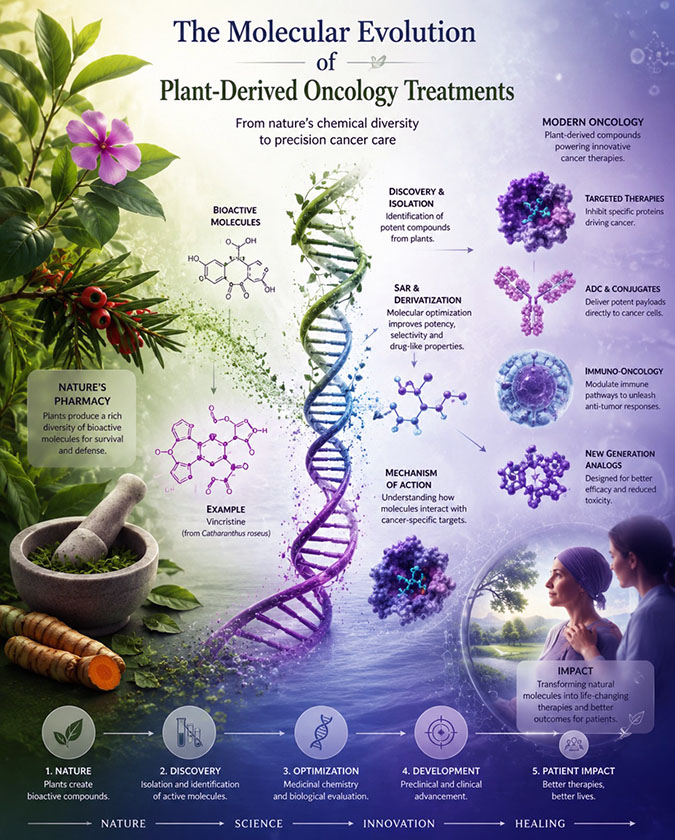
The Molecular Evolution of Plant-Derived Oncology Treatments
For centuries, plants have served as humanity’s earliest pharmacy. Ancient civilizations relied on roots, leaves, bark, and seeds to relieve pain, treat infections, and manage various illnesses. In modern medicine, however, the role of plants has expanded far beyond traditional remedies. One of the most remarkable developments in pharmaceutical science is the emergence of plant-derived compounds as powerful tools in cancer treatment. The molecular evolution of these therapies illustrates a fascinating journey from indigenous knowledge to sophisticated oncology interventions guided by molecular biology and biotechnology.
From Traditional Medicine to Molecular Discovery
The history of plant-based oncology treatments often begins with observations made by traditional healers. Communities around the world identified certain plants that appeared to influence tumors, alleviate symptoms, or improve general health. While many of these claims lacked scientific validation, they provided valuable starting points for researchers seeking biologically active compounds.
The twentieth century marked a turning point in cancer drug discovery. Advances in chemistry enabled scientists to isolate individual molecules from complex plant extracts. Instead of using whole-plant preparations, researchers could identify specific compounds responsible for therapeutic effects and study their mechanisms of action.
This shift represented the first stage of molecular evolution. Plants were no longer viewed simply as medicinal herbs; they became reservoirs of chemically diverse molecules capable of interacting with intricate cellular pathways involved in cancer progression.
The Discovery of Plant Alkaloids
Among the earliest breakthroughs were the vinca alkaloids, isolated from the Madagascar periwinkle (Catharanthus roseus). Originally investigated because of their effects on blood sugar, researchers discovered that these compounds possessed significant anticancer activity.
Vincristine and vinblastine revolutionized oncology by targeting microtubules, structural components essential for cell division. Cancer cells divide rapidly, making them particularly vulnerable to disruptions in mitosis. By interfering with microtubule formation, these alkaloids prevent chromosomes from separating properly during cell division, ultimately leading to cell death.
The success of vinca alkaloids demonstrated that plant compounds could exert highly specific molecular effects rather than merely producing generalized toxicity. This realization encouraged scientists to search systematically for additional plant-derived anticancer agents.
Taxanes and the Transformation of Breast and Ovarian Cancer Therapy
Another milestone emerged from the bark of the Pacific yew tree (Taxus brevifolia). In the 1960s, researchers participating in natural-product screening programs isolated a compound later named paclitaxel.
Paclitaxel introduced a novel mechanism of action. Unlike vinca alkaloids, which inhibit microtubule assembly, paclitaxel stabilizes microtubules and prevents their disassembly. This abnormal stabilization disrupts normal cell division and triggers apoptosis, or programmed cell death.
Initially, paclitaxel faced major obstacles. The extraction process required harvesting large quantities of slow-growing yew trees, raising serious environmental concerns. Scientists responded through innovative approaches, including semi-synthetic production methods using renewable plant materials and, later, advanced manufacturing techniques.
Today, taxanes remain essential components of treatment regimens for breast cancer, ovarian cancer, lung cancer, and several other malignancies. Their development illustrates how molecular understanding and sustainable production strategies can evolve simultaneously.
Camptothecin and the Era of Targeted Enzyme Inhibition
The Chinese ornamental tree Camptotheca acuminata yielded another important discovery: camptothecin. Early investigations revealed impressive anticancer activity, but severe toxicity limited its initial clinical use.
Continued molecular research uncovered camptothecin’s precise target: topoisomerase I, an enzyme responsible for relieving torsional stress during DNA replication and transcription. Inhibiting this enzyme causes DNA damage that selectively affects rapidly dividing cells.
Armed with this knowledge, scientists engineered safer derivatives such as irinotecan and topotecan. These compounds retained therapeutic efficacy while improving pharmacological properties and reducing adverse effects.
The evolution of camptothecin derivatives highlights a critical theme in oncology: understanding molecular mechanisms enables refinement rather than abandonment of promising compounds.
Understanding Cancer at the Molecular Level
Cancer is not a single disease but a collection of disorders characterized by genetic and epigenetic alterations. Mutations affecting oncogenes, tumor suppressor genes, signaling pathways, and DNA repair mechanisms contribute to uncontrolled cellular proliferation.
Plant-derived compounds interact with many of these molecular targets. Some induce apoptosis by activating intrinsic death pathways. Others inhibit angiogenesis, preventing tumors from developing new blood vessels. Certain phytochemicals modulate immune responses, enhance oxidative stress within malignant cells, or interfere with metastatic processes.
This molecular complexity has transformed the development of plant-based oncology treatments. Researchers increasingly seek compounds capable of influencing specific pathways associated with particular cancer types.
Rather than relying solely on broad cytotoxicity, modern strategies emphasize precision and selectivity.
Biotechnology and the Next Generation of Plant-Derived Drugs
One of the greatest challenges in natural-product drug development is supply. Many medicinal plants produce active compounds in extremely low concentrations, making large-scale harvesting impractical or environmentally damaging.
Biotechnology has provided innovative solutions.
Plant tissue culture allows scientists to cultivate cells capable of producing valuable metabolites under controlled conditions. Metabolic engineering modifies biosynthetic pathways to enhance compound yields. Synthetic biology combines genes from plants and microorganisms to generate complex molecules using microbial fermentation systems.
These technologies reduce dependence on wild populations while improving consistency and scalability.
Moreover, genomic sequencing has revealed the intricate networks responsible for synthesizing medicinal compounds. By identifying key enzymes and regulatory genes, researchers can manipulate production pathways with unprecedented precision.
The result is a new era in which the boundaries between natural products and engineered therapeutics continue to blur.
Emerging Phytochemicals in Oncology Research
Beyond established chemotherapy agents, numerous plant-derived molecules remain under investigation.
Curcumin, derived from turmeric, has attracted attention for its anti-inflammatory and antioxidant properties. Laboratory studies suggest it influences multiple signaling pathways involved in tumor growth, including nuclear factor-kappa B (NF-κB) and various growth factor receptors.
Resveratrol, found in grapes and berries, has demonstrated potential effects on apoptosis, angiogenesis, and metastasis in experimental settings.
Epigallocatechin gallate (EGCG), a catechin abundant in green tea, may alter cellular proliferation and promote programmed cell death.
While these compounds show promise in preclinical studies, translating laboratory findings into effective clinical therapies remains challenging. Factors such as poor bioavailability, variable absorption, and insufficient evidence from large clinical trials must be addressed before widespread therapeutic adoption.
Scientific rigor is essential to distinguish genuine potential from exaggerated claims often associated with “natural cures.”
Personalized Medicine and Plant-Based Therapies
The future of oncology increasingly revolves around personalized medicine. Advances in genomic profiling enable physicians to identify molecular characteristics unique to each patient’s tumor.
This individualized approach may reshape the application of plant-derived therapies. Biomarker-driven treatment selection could identify patients most likely to benefit from specific compounds or combinations.
Researchers are also exploring synergistic interactions between plant-derived drugs and immunotherapies, targeted therapies, and radiation treatment. Combining different modalities may enhance effectiveness while minimizing resistance.
Artificial intelligence and computational modeling further accelerate discovery by predicting molecular interactions and identifying novel therapeutic candidates hidden within extensive botanical databases.
Such innovations suggest that the next generation of plant-derived oncology treatments will be guided not only by nature but also by data-driven precision.
Ethical and Environmental Considerations
As demand for natural compounds increases, ethical stewardship becomes increasingly important. Overharvesting medicinal plants threatens biodiversity and disrupts ecosystems. Indigenous communities whose traditional knowledge contributed to drug discovery may also be excluded from economic benefits.
Sustainable sourcing practices, fair benefit-sharing agreements, and conservation initiatives are therefore essential components of responsible pharmaceutical development.
Protecting both biological diversity and cultural heritage ensures that future generations can continue to explore nature’s therapeutic potential.
Conclusion
The molecular evolution of plant-derived oncology treatments reflects one of medicine’s most compelling success stories. What began as observations rooted in traditional healing practices has evolved into a sophisticated scientific discipline integrating chemistry, molecular biology, genomics, and biotechnology.
From vinca alkaloids and taxanes to camptothecin derivatives, plant-based compounds have transformed cancer care by revealing novel mechanisms of action and expanding therapeutic possibilities. Emerging technologies now offer opportunities to discover, optimize, and sustainably produce the next generation of anticancer agents.
Although significant challenges remain, the partnership between nature and science continues to shape the future of oncology. Plants, refined through millions of years of evolution, still harbor molecular secrets capable of changing how humanity confronts one of its greatest medical challenges.
As researchers deepen their understanding of cancer biology and botanical chemistry, the green world around us may yield even more sophisticated solutions—demonstrating that some of the most advanced medical innovations can trace their origins back to the leaves, bark, roots, and flowers that have accompanied human civilization since its earliest days.